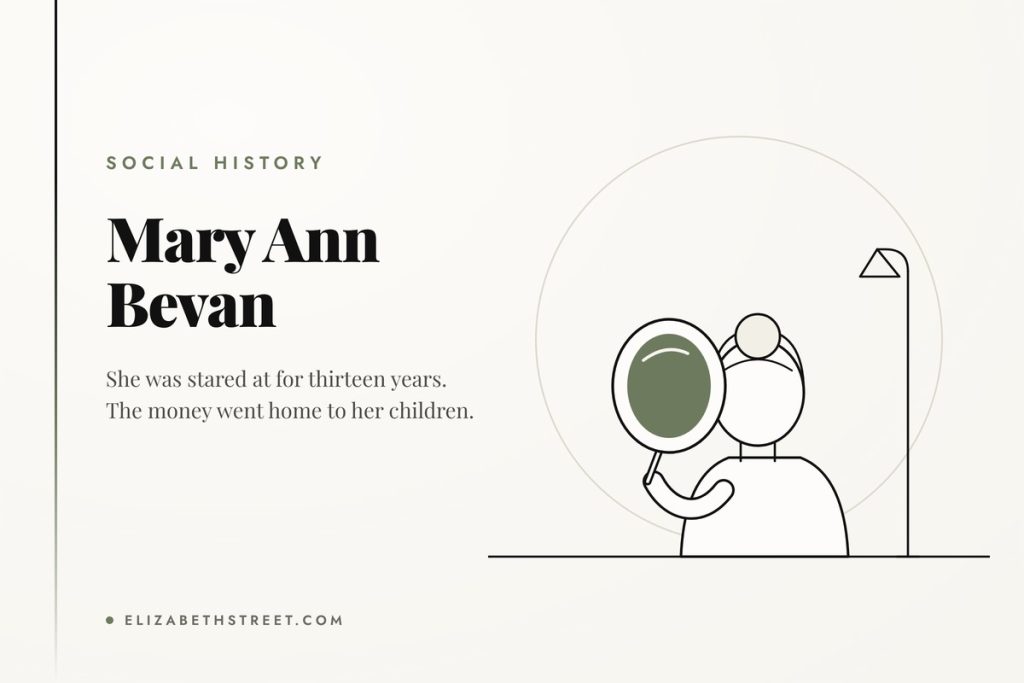
She is remembered under a title she did not choose and would not have wanted. Mary Ann Bevan was a nurse from East London, a wife, and the mother of four children. She spent the last thirteen years of her life being looked at by strangers who had paid for the privilege, and she did it for one reason: the money went home to her children.
This is what is actually known about her, and what the people who met her said at the time.
A nurse from Plaistow
Mary Ann Webster was born on 20 December 1874 in Plaistow, in what is now the London Borough of Newham. She was the eighth of eight children in a working-class family.
In her early twenties she trained and worked as a nurse. Accounts differ slightly on the exact age, and both of the careful sources on her life give a different figure, but they agree she entered the profession young and was working in it well before anything else happened to her. It is worth holding on to that, because almost everything written about her skips it.
In 1902, aged 27, she married Thomas Bevan in Bromley, Kent. They had four children, two girls and two boys. By every surviving account the marriage was an ordinary and happy one.
What acromegaly actually did
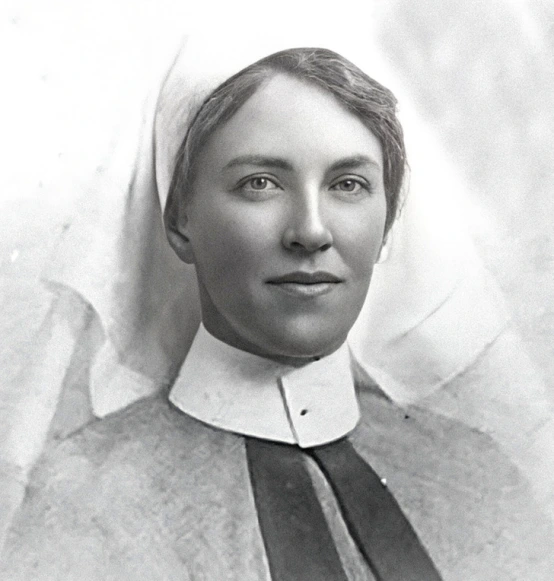
Around 1906, when she was about 32 and four years into the marriage, Mary Ann began to change.
Acromegaly is caused by the body producing too much growth hormone, usually because of a benign tumour on the pituitary gland. In adults, the bones that can still respond to that hormone are the ones in the hands, feet, jaw and brow, which is why the condition reshapes a face so distinctively. It is not a cosmetic condition. The symptoms Mary Ann lived with included severe headaches and eyesight that narrowed and worsened as the tumour pressed on the optic nerves.
Her hands and feet grew too. By 1926 a reporter noted she was wearing size 12 shoes.
It is treatable now, usually by surgically removing the tumour, often alongside medication or radiotherapy. In 1906 there was nothing. She simply had to carry it.
1914
Thomas Bevan died suddenly in 1914. No surviving source records a cause, and anyone who tells you one is guessing.
Mary Ann was 39, visibly altered by a condition nobody could explain to her, and solely responsible for four children. Nursing income alone would not cover them, and by this point her appearance had made steady work difficult to find. She took odd jobs. They were not enough.
It is worth pausing on what the law already allowed her to do. By 1914 the Married Women’s Property Act had been in force for thirty-two years, and as a widow she had full legal capacity in any case. She could have held a bank account in her own name without asking anyone. The question of when women could open a bank account has a longer and far less tidy answer than most people assume — and in her case it was beside the point entirely. A right over your own money assumes you have some. Mary Ann Bevan had four children, no income, and one asset nobody had ever taught her to think of as an asset.
The advertisement
At some point after her husband’s death, Mary Ann answered a newspaper advertisement for an “Ugliest Woman” contest. She entered it. She won.
It is a detail that tends to get told as grotesque, and it was. But read it the other way round: a widow with four children and no employable prospects found the one thing the world was prepared to pay her for, and she took it. That is not a tragedy happening to someone. That is a decision.
Coney Island, 1920
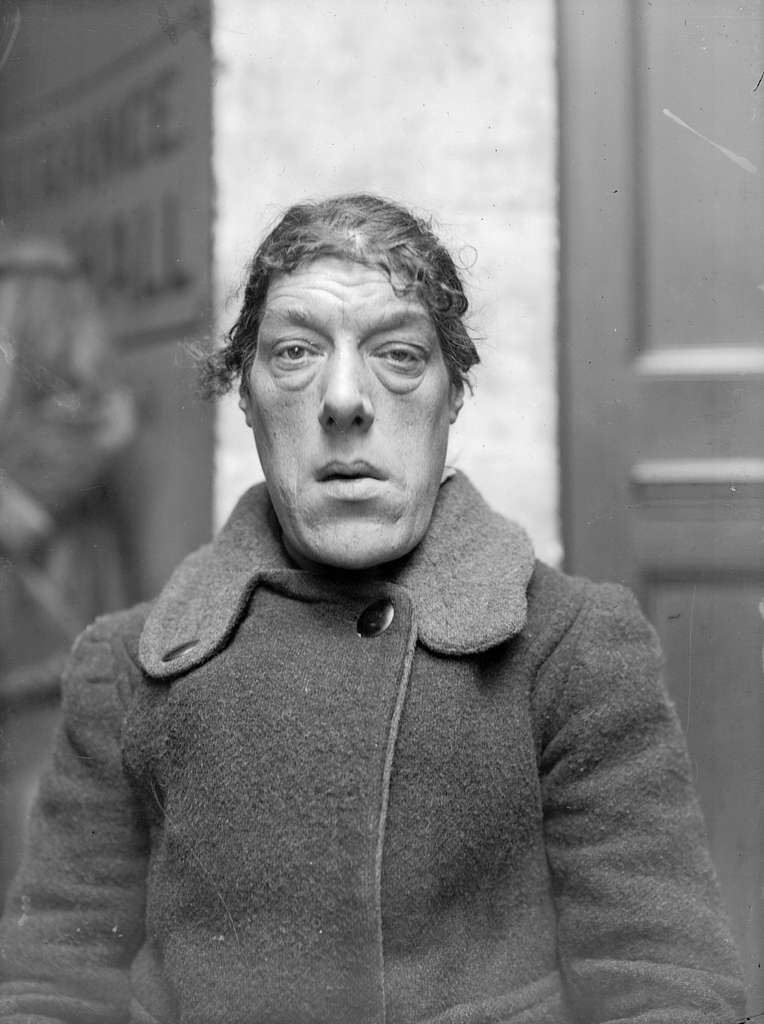
In 1920 the American showman Samuel W. Gumpertz hired her for the sideshow at Dreamland, the amusement park at Coney Island in New York. She crossed the Atlantic and began work.
She later also appeared with the Ringling Brothers Circus, and notably not only as a performer. She worked there as a nurse as well. The profession she had trained for in her twenties was still hers, even on a circus lot. She stayed on the American sideshow circuit for the rest of her life.
Across those years she is reported to have earned more than $50,000, supplemented by selling picture postcards of herself to the people who came to look. That figure reaches us second-hand rather than from any payroll record, so treat it as an estimate rather than an account. What is consistently reported is where it went: her children’s upkeep and their education, which both sources agree was the entire point of the exercise for her.
The surgeon who objected
Here is the part almost nobody tells.
Mary Ann’s physician was Harvey Cushing, the American neurosurgeon who effectively founded the field and whose research established how pituitary tumours work in the first place. In 1927, Time magazine ran a piece about her written in its usual arch style. Cushing wrote to the magazine to complain.
Being a physician, I do not like to feel that Time can be frivolous over the tragedies of disease.
Harvey Cushing, letter to Time, 1927
One of the most eminent doctors alive took the time to tell a national magazine to stop being clever about his patient. It did not change how she was billed, and it did not stop anyone buying a ticket. But somebody said it, in print, while she was still alive.
She hated being pitied
In 1926 the Leeds Mercury sent a reporter to meet her. The resulting description is the closest thing we have to a first-hand impression of what she was actually like: a pleasant woman, enjoyable to talk to, who hated being pitied.
That last clause is the one to sit with. The sentimental version of this story, the one that circulates on social media with a sad-face emoji, is a version she explicitly did not want. She was not asking to be felt sorry for. She was working.
Her last wish
Mary Ann Bevan died on 26 December 1933, aged 59.
Her final wish was to be buried in England, and it was honoured. She lies in Brockley and Ladywell Cemeteries in south London, about eight miles from Plaistow, where she was born.
The greeting card
In the early 2000s, Hallmark used a photograph of Mary Ann on a birthday card sold in the UK, with a joke referencing the television dating show Blind Date.
A Dutch physician, Wouter de Herder, complained, his objection recorded in the British Medical Journal in November 2006, on the grounds that it was disrespectful to a woman whose appearance was the result of a disease. Hallmark agreed that the card was inappropriate and withdrew it from distribution.
Seventy years after her death, it still took a doctor to point it out.
What she should be remembered for
Mary Ann Bevan was a trained nurse who developed a pituitary tumour at 32, was widowed at 39 with four children, and found a way to pay for their upbringing in a world that offered her exactly one option. She did that work for thirteen years, kept nursing while she did it, sent the money home, and asked to be buried in England.
The title she is filed under is the one thing about her that was never hers. Everything else, the training, the marriage, the four children, the decision, the thirteen years, the last wish, she chose or she carried.
Frequently asked questions

What medical condition did Mary Ann Bevan have?
Acromegaly, caused by excess growth hormone, usually the result of a benign tumour on the pituitary gland. Her symptoms began around 1906, when she was about 32, and included changes to her facial structure, severe headaches and deteriorating eyesight.
How many children did Mary Ann Bevan have?
Four, two girls and two boys, with her husband Thomas Bevan, whom she married in 1902. Thomas died suddenly in 1914, leaving her their sole support.
How did Mary Ann Bevan die, and how old was she?
She died on 26 December 1933 at the age of 59, still working on the American sideshow circuit. At her own request she was buried in England, at Brockley and Ladywell Cemeteries in London.
Is acromegaly treatable today?
Yes. It is usually treated by surgically removing the pituitary tumour, often alongside medication or radiotherapy. None of that existed in 1906.