
Ask the internet when women were allowed to open a bank account, and you will get a date: 1974. It appears on bank websites, in explainer videos, on infographics shared every March. It is the answer most people now believe.
It is also wrong, and not in a small way. The law passed in 1974 was about credit, not deposit accounts. Women had been opening bank accounts for well over a century by then, and in some states the explicit right to do so was more than a hundred years old.
What was happening instead is both more complicated and more interesting. The barriers women ran into were real, documented and sometimes humiliating, but most of them were not laws. They were the private policies of banks and department stores, applied unevenly, defended with legal excuses that often failed, and finally dragged into the open by a congressional commission and a television news anchor whose store card was cancelled for changing her surname.
The short answer
For single women and widows in the United States, there was never a general legal prohibition on holding a bank account. They were legally capable of contracting in their own name.
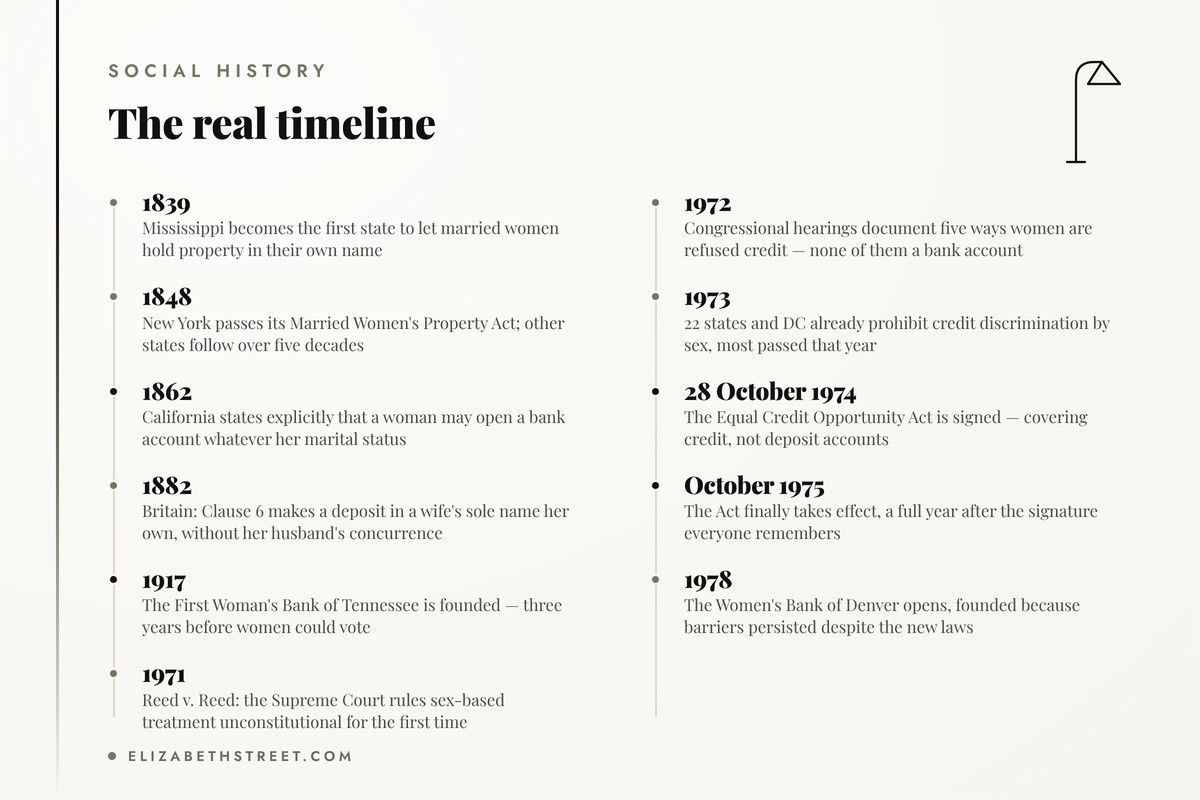
For married women, the obstacle was the common-law doctrine of coverture, which was dismantled state by state from 1839 onward. Mississippi moved first; New York followed in 1848; California is generally credited as the first state to say explicitly, in 1862, that a woman could open a bank account regardless of whether she was married. By the early twentieth century, every state had passed a Married Women’s Property Act.
What changed in 1974 was something narrower and, in daily life, very significant: the Equal Credit Opportunity Act made it illegal for a lender to discriminate on the basis of sex or marital status when granting, refusing or setting the terms of credit. Credit cards, loans, mortgages. Not chequing accounts.
And in Britain the picture is different again, with a date most British articles get wrong too. More on that below.
Coverture: the thing that was actually in the way
Under English common law, inherited by the American colonies, a married woman was a feme covert — a covered woman. Her legal identity was absorbed into her husband’s. She could not own property in her own right, could not enter a contract, could not sue or be sued alone. Her earnings were his. Her inheritance was his to manage.
This is the root of every subsequent confusion, and it is why the question “could women open bank accounts” has no single answer. An unmarried woman was a feme sole with full contractual capacity. The same woman, on her wedding day, lost it. Widowhood gave it back.
So the story is not about women being excluded from banking. It is about marriage being a legal event that temporarily erased a woman’s financial personhood — and about how long the habits of that system outlived its repeal.
The American timeline
1839 — Mississippi. The first state to let married women hold property in their own name. It is worth being honest about the context: the cases driving it concerned the ownership of enslaved people, and the reform was as much about protecting family assets from a husband’s creditors as about women’s independence.
1848 — New York. The Married Women’s Property Act that most histories treat as the turning point passed the same year as the Seneca Falls Convention. Other states followed over the next five decades.
1862 — California. Credited as the first state to state explicitly that a woman could open a bank account, whatever her marital status.
1862 — the Homestead Act. Signed by Lincoln, it allowed single women to claim land in their own name without a male co-signer. Thousands did.
By the time the Equal Credit Opportunity Act was being debated in the early 1970s, the legal groundwork was a century old. As Margaret J. Gates put it in the Vanderbilt Law Review in April 1974 — writing while the bill was still in Congress — every state had a Married Women’s Property Act, enacted precisely “to nullify the common-law disabilities of married women.”
Which raises the obvious question. If the law had changed, why hadn’t anything else?
What was actually happening in the 1960s and 1970s
Gates’s paper is unusually useful because it was written before the Act passed, by someone cataloguing the problem rather than commemorating its solution. Her conclusion was blunt: the obstacles were mostly creditor practice, not statute. The laws creditors pointed to, she noted, applied “only to married women” — and even those were thinner than claimed.
Three legal arguments were commonly offered. Support laws, which obliged husbands to maintain wives. Community property rules in eight states, though by 1974 Louisiana was the only one still preventing a wife from obligating her own income. And “multiple agreement” provisions in the Uniform Consumer Credit Code and the Uniform Small Loan Law, written to stop couples dodging interest-rate ceilings by splitting accounts, which in practice fell hardest on women.
Gates’s verdict on all three was that “quite likely” the real reason creditors resisted opening accounts for married women was cost and preference rather than any legal barrier.
The retailers were not especially coy about it. A Sears spokesman, quoted in Business Week in January 1974, said the company discouraged married women from opening their own accounts — “but if they push us on it, we’ll go along.”
That single sentence is the whole era. Not prohibited. Discouraged. Available to the woman stubborn enough to insist, and quietly withheld from everyone else.
The five findings that built the case
In May 1972 the National Commission on Consumer Finance held hearings on the availability of credit to women. Counsel for the American Bankers Association, Matthew Hale, gave testimony on 23 May. The Commission’s published findings, in Consumer Credit in the United States, set out five problem areas, and they are worth reading in full because they are far more specific than the summary that has replaced them:
- Single women had more trouble obtaining credit than single men, particularly mortgage credit.
- On marrying, a woman was required to reapply for credit, usually in her husband’s name. Men were not asked to do this.
- Creditors were unwilling to extend credit to a married woman in her own name.
- Creditors were unwilling to count a wife’s income when assessing a couple.
- Divorced and widowed women had difficulty re-establishing credit — and separated women had it worst of all, because the accounts were often still in the husband’s name.
The Senate Banking Committee went further, listing thirteen practices. The first five mirrored the Commission’s. The others included refusing a working wife an account she would have qualified for had she been single, questioning her about her husband’s creditworthiness, and classifying her as her husband’s “dependent” regardless of what she earned. The committee also objected to alimony and child support being treated as non-income, and to applications that asked women about their use of birth control.
Note what is in that list and what is not. Nobody is testifying that women could not have a bank account. They are testifying about reapplication, income discounting, co-signatures and the treatment of alimony — the machinery of credit, operated by private companies, on their own terms.
Jorie Lueloff and the cancelled card
The testimony that reads most vividly came from Jorie Lueloff, who became Chicago’s first female news anchor at WMAQ in 1966 and appeared before the Commission in Washington in 1972.
She had married. That was the whole of her offence.
At Marshall Field & Co., a clerk told her: “We don’t care about women.” Bonwit Teller closed her account outright rather than reissue it in her married name. American Express began sending her bills to her husband; when he paid them, the company suspended his card.
“a woman should have to forfeit her economic identity because she changed her name”
Jorie Lueloff, testifying before the National Commission on Consumer Finance, 1972
She was a woman with a public profile, a salary, and a national platform, and she still couldn’t keep a department store account through a change of surname. That is the gap between what the law permitted and what the counter actually did.
Four different women, four different answers
Almost every article on this subject treats “women” as one category. The contemporary record does not. The experience depended enormously on marital status, and the differences are the most useful part of the story.
Single women
Legally unobstructed and, in practice, the group most likely to hold accounts in their own name. Their difficulties clustered around mortgages rather than deposit accounts. The federal student loan figures are indicative: Department of Health, Education and Welfare data on guaranteed student loans as of 30 June 1972 showed women receiving fewer loans than men in 53 of 54 jurisdictions. In Alabama, the split was 63.8 per cent male to 35.6 per cent female.
Married women
The group the whole fight was really about. Legally capable of contracting in almost every state, routinely required to reapply in a husband’s name, and frequently told that a separate account was not something the institution preferred to offer.
Divorced women
Gates described divorced women as “new faces” to the credit system — people with years of repayment history recorded under a husband’s name and therefore, as far as a lender was concerned, no history at all. Alimony was often counted against them rather than as income. A 1973 report by the Missouri Commission on the Status of Women worked through exactly that calculation.
Meanwhile a divorced man was under no obligation to tell his creditors that anything had changed.
The irony is that the lenders’ own numbers did not support the caution. Charles Hayward, a vice-president at First National City Bank interviewed in December 1973, said divorced women were good risks — and that a divorced man was twice as likely to default as a married one.
Widows
Legally restored to full capacity, and practically in the same position as divorcées: decades of creditworthiness filed under someone else’s name. The Commission’s language was that widowed women “emerge as unknowns”.
Were women actually worse credit risks?
No, and this was known at the time rather than discovered afterwards.
Gates stated plainly that “there is no direct evidence that women are poorer credit risks”. Studies going back to Durand in 1941, and again Smith in 1964, found women to be better risks than men. A Neighborhood Housing Services programme recorded a delinquency rate of 2 per cent among female-headed households.
The existence of those studies tells you something in itself: women were already a substantial part of the instalment credit market. You do not commission repayment research on a group that is not borrowing.
Even the industry conceded the point. Eugene Adams, then president of the American Bankers Association, told American Banker in June 1973 that banks “do in fact discriminate against women”.
What 1974 actually changed
Two points about the Equal Credit Opportunity Act are routinely missed, and both matter.
It was not the first legal protection. By the time it passed, 22 states and the District of Columbia already had laws prohibiting credit discrimination by sex — most of them enacted within the previous year. Illinois was among them: Governor Dan Walker signed a state bill in September 1973, covering retail credit and credit cards, under which a rejection could not be “because you are a woman or a wife”. The federal Act consolidated a wave that was already breaking.
It did not take effect when it was signed. President Ford signed it on 28 October 1974, as one part of a wider banking bill — legislation that opened with deposit insurance rates. The credit provisions then sat for a full calendar year before coming into force, which puts the real operative date in late October 1975.
So the anniversary everyone marks is the signature, not the change.
The Act prohibited discrimination on the basis of sex or marital status in granting credit, refusing it, or setting its terms. Campaigners at the time complained that it lacked teeth; punitive damages were capped at $10,000.
It was strengthened in 1976. Those amendments, signed by Ford on 23 March 1976, extended the protections to race, colour, religion, national origin, age and receipt of public assistance. Creditors had 30 days to respond to applications, and both the Attorney General and private citizens had standing to sue. Lenders could still ask about marital status, age and public assistance, provided the information was not used, in the legislation’s framing, in a biased or arbitrary way.
The legal groundwork: Reed v. Reed
Three years before the Act, the Supreme Court heard argument on 19 October 1971 in a case about something apparently mundane: an Idaho statute that preferred men over women as administrators of a deceased person’s estate.
Ruth Bader Ginsburg co-wrote the brief. The Court ruled unanimously that treating people differently on the basis of sex was unconstitutional — the first time it had done so. Reed v. Reed is the doctrinal hinge on which the credit legislation later swung.
Britain: a different country and a different date
British versions of this story usually land on 1975 — the year of the Sex Discrimination Act — and claim women could not open bank accounts before it. The archivist and historian Lesley Hall, who has written on the subject, describes being “given a considerable jolt” by exactly that claim.
She had opened a Trustee Savings Bank account as a girl and a chequing account with the National Provincial when she went up to university in the mid-1960s — a decade before the date in the infographics.
The relevant statute is far older. Clause 6 of the Married Women’s Property Act 1882 treats a bank deposit held in a married woman’s sole name as her separate property, and states that this is sufficient prima facie evidence of her entitlement to it without the concurrence of her husband. Parliament was legislating about married women’s bank accounts in 1882 because married women had bank accounts in 1882.
The supporting evidence runs earlier still. NatWest’s own historical material records female bank customers from the late seventeenth century. Elizabeth Gaskell’s Cranford, published in 1853, turns on a bank failure and its effect on a woman’s finances. Emma Sophia Galton’s Guide to the Unprotected (1864) was written to help women manage their own money and warns against holding shares in joint-stock banks.
Hall concludes that individual banks or managers may well have demanded a husband’s countersignature as a matter of house policy, “but nonetheless” British women “were legally able to open bank accounts and have sole access to them”.
Which is the same distinction as the American one, arrived at from the other side of the Atlantic: the law said yes, and the branch did as it liked.
The women who built their own banks
If you want the single fact that collapses the whole myth, it is this: the First Woman’s Bank of Tennessee was founded in 1917 — fifty-seven years before the Equal Credit Opportunity Act, and three years before American women could vote in a federal election.
Women were not waiting to be let into banking. Some of them were running it.
The more revealing example, though, comes after 1974, and it is the best evidence that the law did not finish the job.
In 1975 — the year the Equal Credit Opportunity Act came into force — a Denver businesswoman named Carol Green and an activist named Bonnie Andrikopolous formed an association to explore setting up a bank run by women. Members paid $1,000 each to join. Over the following three years, the group raised two million dollars and secured a national charter.
The Women’s Bank N.A. of Denver opened on 14 July 1978. Ten incorporators signed it into existence, including Leslie Friedman Davis, Betty Sue Friedman, Beverly Martinez-Grall, Edna Mosley, Loretta Norgren, Barbara Welch Sudler, and Judith Foster Wagner. LaRae Orullian was recruited as its first president and chairwoman.
The reason given for founding it is the part worth sitting with. Not that women were barred. That women faced barriers to credit and financial services despite the new laws.
Four years after the Act was signed, three years after it took effect, a group of women in Colorado concluded that the quickest route to being served properly was to charter their own bank and do it themselves.
It worked. The bank was profitable within its first year and has a reasonable claim to being the most successful of the women’s banks of that era. Its shareholders sold to investors in 1994, and in 1997 it was renamed the Colorado Business Bank.
That arc — a law in 1974, a bank founded in 1978 because the law was not enough, and a name change in 1997 once it no longer needed to be a women’s bank at all — is a far better answer to the original question than any single date.
Why the myth took hold
Four things compressed a messy century into one tidy, wrong date.
Credit and deposits got merged. “Could not get a credit card in her own name” is broadly true for many married women in 1970 and became “could not open a bank account”, which is not.
Practice was mistaken for law. If every bank in your town demands your husband’s signature, the distinction between prohibition and policy is academic — until you try to write the history, at which point it is the entire point.
Marital status was flattened. The single-woman experience and the married-woman experience were genuinely different, and collapsing them produces a sentence that gets both wrong.
A signing date is quotable. “1974” fits in a caption. “A century of state property acts, followed by twenty-two state credit laws, followed by a federal act that took effect in 1975” does not.
There is a cost to the tidy version, and it is not pedantic. It makes the barrier sound like a rule that someone eventually repealed, when in fact it was a hundred years of institutions choosing, every day, at every counter, to treat a legal right as optional. The women who pushed through it did not need the law changed. They needed to be believed. That is harder to fix and more honest to remember.
History has not been kind to women who were looked at rather than listened to, and the pattern runs well beyond banking. Mary Ann Bevan spent the last thirteen years of her life being stared at by strangers who had paid for the privilege, and she did it for one reason: the money went home to her children. Her name survives attached to a title she never chose. Jorie Lueloff’s name survives attached to a store account that was closed because she got married. Both were decided for them by institutions that had already made up their minds.
Frequently asked questions
Could a woman have her own bank account in the 1950s?
Yes. Single women and widows could do so without legal obstacles, and married women could hold accounts in their own name since the Married Women’s Property Acts, with California explicitly permitting it as early as 1862. Individual banks sometimes asked for a husband’s signature as a matter of policy, but that was the institution’s choice, not a legal requirement.
Could a single woman get a credit card in 1971?
Often yes, and single women generally found it easier than married ones. The National Commission on Consumer Finance found in 1972 that single women’s difficulties were concentrated in mortgage lending rather than ordinary consumer credit. The acute problems arose on marriage, when a woman was typically made to reapply in her husband’s name.
Could women open their own bank account before 1974?
Yes, and for a very long time before it. The Equal Credit Opportunity Act of 1974 addressed credit, not deposit accounts. By then every US state had a Married Women’s Property Act on the books and 22 states plus the District of Columbia had already banned credit discrimination by sex.
What year could a woman get a loan without a man?
There is no single year, which is why the question is so hard to answer cleanly. Many women obtained loans in their own name well before the 1970s. What the Equal Credit Opportunity Act did — signed 28 October 1974, in force a year later — was make it unlawful for a lender to require a co-signature, discount a wife’s income, or refuse an application on the grounds of sex or marital status.
When could women get credit cards in their own name?
Women held store and bank cards from the earliest years of consumer credit, but keeping one through marriage, divorce, or widowhood was the difficulty. Jorie Lueloff’s 1972 testimony — a Bonwit Teller account closed rather than reissued in her married name — is the clearest documented example. The enforceable right to be assessed on your own creditworthiness dates to the Equal Credit Opportunity Act, which took effect in late 1975.
Sources
Margaret J. Gates, “Credit Discrimination Against Women: Causes and Solutions”, Vanderbilt Law Review, vol. 27, April 1974. National Commission on Consumer Finance, Consumer Credit in the United States, 1972. Senate Banking Committee, S. Rep. No. 278, 93rd Congress. US National Archives, “On the Basis of Sex: Equal Credit Opportunities”. Contemporary reporting in Business Week (January 1974), American Banker (June 1973) and the Chicago Sun-Times. Lesley A. Hall, “Surely some misapprehension? British women’s rights to bank accounts”. Married Women’s Property Act 1882, Clause 6.