
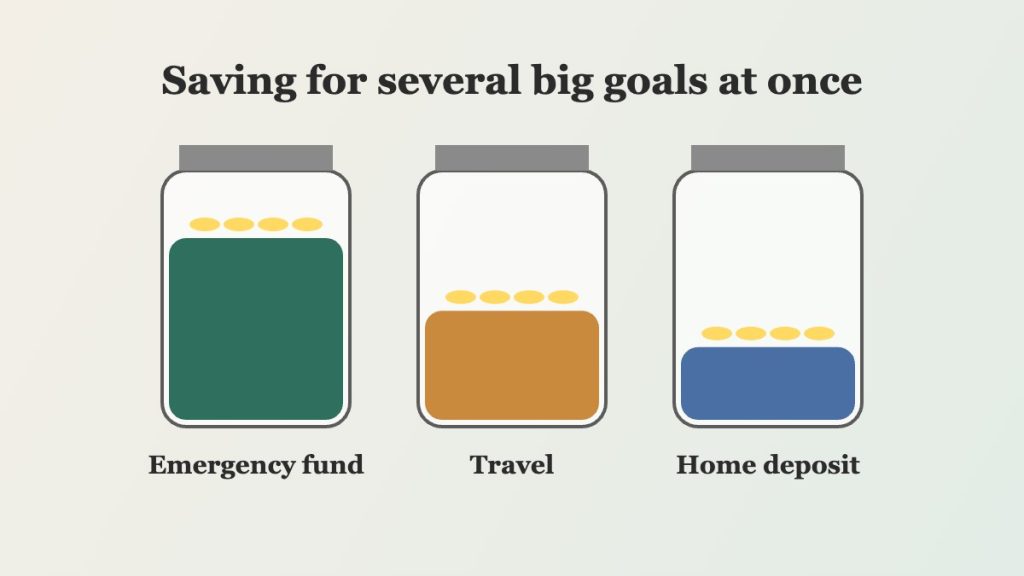
Life rarely unfolds one goal at a time. Chances are you will be building an emergency fund while also planning a family trip, saving for a home down payment, or preparing for higher education. Many Filipinos also juggle responsibilities like supporting parents, contributing to household expenses, or preparing for future family needs. When several priorities compete for your attention, it can feel as though progress toward any one goal is slow or uncertain.
Fortunately, working toward multiple goals simultaneously is more achievable than it first appears. The key is learning how to structure your savings in a way that gives each objective a clear place within your financial plan. Here’s how to create that structure for yourself.
1) Clarify Each Goal and Its Timeline
Before you can effectively save for multiple goals, you need a clear picture of what you’re working toward. Many people say they want to save money for “the future,” yet this broad idea often makes it difficult to maintain consistent motivation. It also makes it easy to postpone contributions or lose track of progress.
Instead of letting your goals remain undefined, identify major financial objectives and assign a realistic timeline to each one. Perhaps you hope to travel abroad within two years, build a six-month emergency fund over the next eighteen months, or accumulate a housing down payment within five years. When you know exactly what you’re saving for and when you hope to achieve it, each deposit begins to feel purposeful rather than merely routine.
2) Choose a Bank That Supports Goal-Based Saving
One of the most common challenges people face when saving for multiple goals is keeping everything organized. Specifically, when all your money sits in a single account, it becomes difficult to track how much is set aside for each purpose and even easier to accidentally spend what you had earmarked for something else.
Fortunately, top banks in the Philippines like Maya have developed products specifically designed to solve this problem, offering distinct solutions depending on what you’re saving for and how you want your money to work. For example, some banks offer high-interest savings accounts that reward you for completing tasks or meeting certain conditions, such as paying bills using their app, buying prepaid load, or shopping online. These boosted rates give your money a chance to grow faster without requiring you to lock it away entirely.
On the other hand, if you’re saving toward a long-term milestone, such as a home down payment, a child’s tuition, or a major purchase, time deposits can be a stronger fit. They typically range from as short as three months to one year, so you can match the lock-in period to your actual target date and keep renewing the account as needed. The trade-off is limited access to your funds, but that restriction can actually work in your favor by discouraging premature withdrawals.
Also, if you prefer to manage multiple goals under one roof, several banks allow you to open sub-accounts within a single savings account. Each sub-account functions as its own financial “envelope” so you can have one for a vacation, a special occasion, or a side hustle while still being accessible under a single set of credentials. This structure keeps your finances consolidated without blurring the boundaries between goals.
3) Prioritize Goals Based on Urgency and Importance
Although it may seem tempting to divide your savings equally among all goals, doing so can slow progress. After all, different financial milestones often carry different levels of urgency. For example, an emergency fund deserves immediate attention because it protects you from unexpected expenses such as medical bills, sudden repairs, or temporary income interruptions. Compared to that, buying a new cellphone when your current one still works fine isn’t as important.
4) Break Down Big Goals into Manageable Monthly Targets
Large financial goals can sometimes feel intimidating simply because of their size. For instance, seeing a target like PHP 500,000 for a housing down payment or PHP 100,000 for a travel fund may initially seem overwhelming.
However, the emotional weight of these numbers can fade once you divide them into smaller monthly contributions. For instance, if you plan to save PHP 120,000 for a goal over three years, that translates to roughly PHP 3,300 per month. Viewed this way, the target becomes much more achievable.
Monthly targets also make it easier to integrate saving into your regular budget. Just as you allocate money for groceries, utilities, and transportation, you can treat your savings contributions as a consistent financial responsibility.
5) Review and Adjust Your Plan Regularly
Even the most carefully designed financial plan needs occasional adjustments. After all, income levels can change, expenses may shift, and new priorities can emerge. So, review your savings strategy every few months to assess whether your current contributions still align with your goals. If your income increases or you get a bonus, you may decide to accelerate certain goals. On the other hand, if expenses temporarily rise, you can adjust contributions without abandoning your long-term plan.
Regular check-ins also provide reassurance. Watching your progress over time helps you see how consistent habits gradually lead to meaningful financial growth.
Build a System That Supports Your Multiple Goals
Saving for multiple goals is ultimately less about juggling several targets and more about building a system that works with your habits. You don’t need to pursue everything at once with equal intensity. You just need to steadily move each one forward, so that your emergency fund grows quietly in the background while your travel savings builds alongside it and your car loan plans don’t stall. With the right bank, the right account structure, and a strategy tailored to your actual goals, saving builds a financial foundation strong enough to support both your ambitions and the people who depend on you.