The ground doesn’t settle into one form. It changes in small ways, then larger ones, then back again. At first, it feels steady. Then the texture shifts underfoot, and you notice it only after a few steps.
There’s a sense of heat in the distance, though it doesn’t reach you directly. The air carries it faintly, then loses it again.
Nothing holds long enough to feel fixed.
Where the Slope Rises
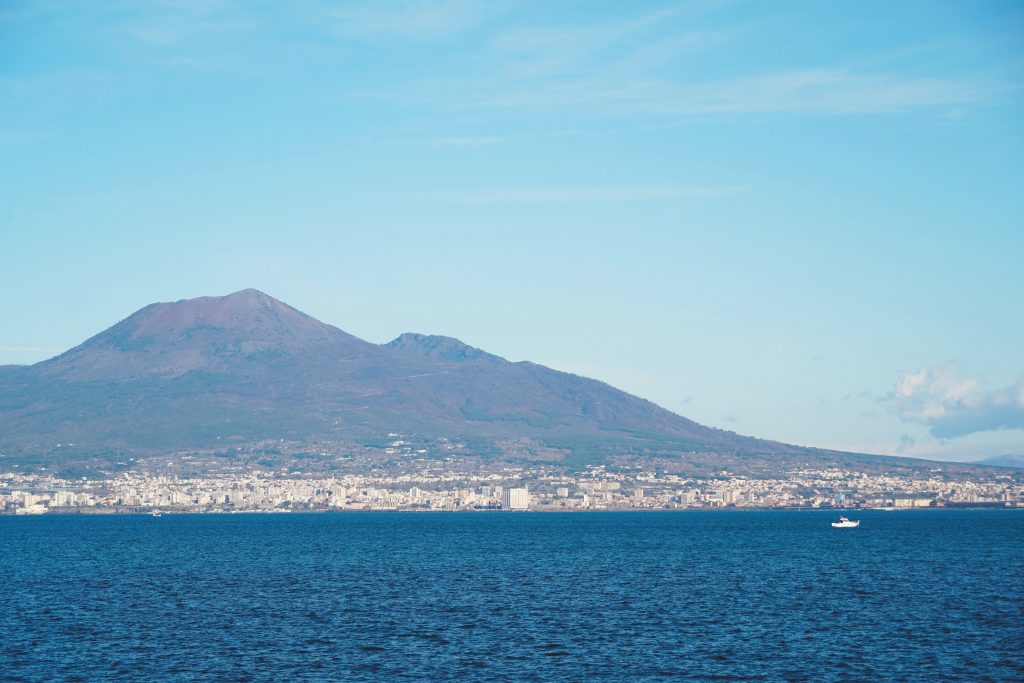
Vesuvius doesn’t present a single outline. It builds through layers.
The lower ground feels uneven, shaped by movement that isn’t immediately visible. The slope rises gradually, though it doesn’t follow a smooth line. Some sections appear sharper, others worn down.
A route displayed on a nearby board includes the Rome to Naples train, though it barely interrupts the stillness around it. The mountain remains unchanged.
You look upward, though the full shape doesn’t stay clear for long.
What the Surface Carries
The ground feels different here. Darker in tone, rougher in texture.
Small fragments shift underfoot. Stones move slightly, then settle again.
There’s no single pattern to follow. The surface changes from one step to the next.
Light falls unevenly. Some areas reflect it, others absorb it completely.
What the Fields Hold
The land feels arranged, though not strictly.
Lines appear across the surface, though they don’t hold perfectly. Some follow the shape of the ground, others cut across it slightly.
You notice the change in texture first. Then the wider view.
At one point, a timetable overhead briefly includes the train from Florence to Rome, before shifting to something else. It doesn’t stay long enough to matter.
The landscape continues.
Between One Step and the Next
Walking doesn’t form a steady rhythm. You adjust constantly. One step feels stable, the next less so.
The slope doesn’t guide you directly. It allows movement, but not in a fixed direction.
You stop briefly, then continue without marking when.
Movement That Continues
At some point, the landscape begins to soften. The slope lowers. The ground becomes less fragmented. The sense of distance shifts slightly.
You don’t notice when it begins. Only that it already has. The air changes as well. It feels less sharp, more open.
Where the Land Opens
The Roman Campagna doesn’t arrive all at once. It spreads gradually. Fields replace stone, though not immediately. The ground flattens, then rises again in softer curves.
Green returns, though not in the same way as before. It feels more even, less interrupted.
The horizon becomes more noticeable here.
Between Open and Uneven
The difference between the volcanic slope and the open fields doesn’t feel sharp.
One feels broken, the other continuous. Still, the movement between them remains steady.
You don’t mark where one ends.
The Line That Extends
Distance feels different here. The land stretches outward, though it doesn’t feel far in a fixed way. The curves repeat, though not exactly.
You walk without aiming toward a clear point.
Nothing suggests an end.
What Doesn’t Settle
The contrast between the two landscapes remains visible, though it doesn’t organise itself.
The darker ground, the softer fields—they stay separate, but not disconnected.
You notice it gradually. It doesn’t resolve into something definite.
The Space Between Terrains
The transition doesn’t divide into stages.
It carries through in smaller shifts. Rough surface to smoother ground. Steeper slope to gentler curves. Nothing interrupts it. You don’t feel like you’ve arrived somewhere entirely different.
A Landscape That Continues
Looking back, the details don’t return in order. The dark volcanic ground. The lighter fields. The way the air changed between them. They don’t form a sequence.
They sit alongside each other, without needing to connect directly. There’s no clear ending point. It continues, steady and unfinished.