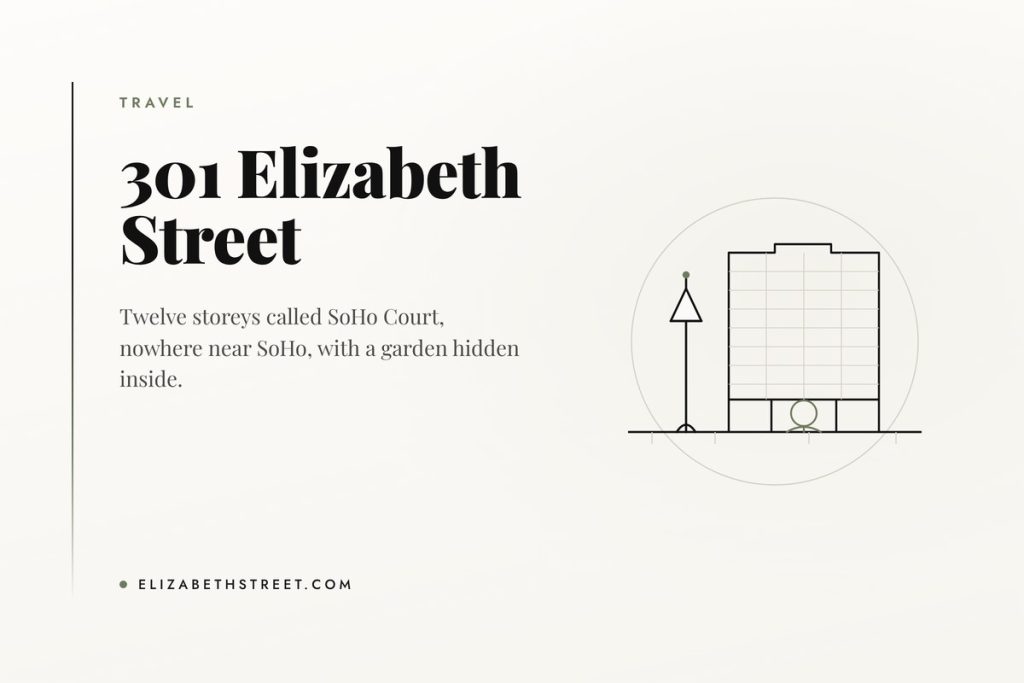
At the top of Elizabeth Street, where it meets East Houston, there is a twelve-storey brown brick building with 195 apartments in it and a courtyard garden hidden in the middle.
It is called SoHo Court.
It is not in SoHo.
Three neighbourhoods, none of them SoHo
301 Elizabeth Street sits in the Little Italy Special Zoning District, a planning boundary the city drew in 1977. Most property websites file the building under NoHo. Anyone standing outside it would probably say Nolita, since Elizabeth Street is Nolita’s spine and this is the top of it.
SoHo is the one answer nobody gives. SoHo is south of Houston, which is where the name comes from, and 301 Elizabeth Street is on the wrong side of it.
This is not a scandal. It is a reasonably ordinary piece of New York marketing, and it has been going on since the building was converted. But it does make 301 a useful illustration of how soft the lines are around here. One address, three defensible labels and a fourth on the door.
What it actually is
- Twelve storeys, with the top floor set back about six feet from the façade below
- 195 apartments
- Converted in 1996
- Architect: Schuman Lichtenstein Claman & Efron
- Developer: the Zucker Organization, led by Donald Zucker
The exterior is brown brick with a layered cornice and a two-storey base in decorative brickwork, under a marquee entrance. Inside there is a concierge, a live-in superintendent, a garage, laundry and a pet policy that lets animals in.
Kitchens run to maple cabinets and granite counters, which dates the fit-out precisely to the decade it was done in. The penthouses are the interesting ones: skylights, fireplaces, terraces and private lift access.
The courtyard
The best thing about 301 Elizabeth Street is the part you cannot see from the street.
There is a landscaped garden courtyard in the middle of the block. When Alan S. Oser wrote about the building for the New York Times in 1996, he described it as a secluded meeting space for tenants, which is a precise description of a thing that almost no building of this size in Lower Manhattan has.
Downtown, outdoor space usually means a roof or a fire escape. A ground-level planted courtyard inside the block, in a building with nearly two hundred apartments in it, is genuinely unusual.
Where it sits on the street
301 is the end of Elizabeth Street as most people experience it. Walk north from here and you are across Houston and into NoHo within a few steps. Walk south and the street becomes the Nolita everybody means when they say Nolita: Sézane at 254, the hand-laid brick of 211, Elizabeth Street Garden, Dante at 210, and eventually Kenmare and the Chinatown end.
It is also one of the few genuinely large residential buildings on a street made mostly of small ones. Nearly two hundred households in a single structure, on a street where fifteen apartments counts as a building.
Frequently asked questions
Is SoHo Court in SoHo?
No. 301 Elizabeth Street is north of Houston Street, which puts it outside SoHo entirely. It sits in the Little Italy Special Zoning District and is usually listed under NoHo or Nolita.
How many apartments are in 301 Elizabeth Street?
195, across twelve storeys.
When was 301 Elizabeth Street built?
It was converted in 1996 by the Zucker Organization, with Schuman Lichtenstein Claman & Efron as architects.
Does 301 Elizabeth Street have outdoor space?
Yes, a landscaped courtyard garden inside the block, plus private terraces on the penthouse level.
A last thought
New York buildings get named after the neighbourhood their developer wished they were in, and the names outlive the wish. SoHo Court will be called SoHo Court long after anybody remembers that SoHo was ever a selling point.
Meanwhile the thing that actually makes it worth knowing about has nothing to do with the name. There is a garden in the middle of it, and almost nobody on the street has ever seen it.